A mature oak leaning over a driveway, a maple with a splitting trunk, or a dead limb above a patio can turn from a landscape concern into a property emergency quickly. Tree hazard mitigation gives Fairfield homeowners a practical way to identify and address those risks before high winds, heavy snow, saturated soil, or everyday gravity expose a failure.
The goal is not to remove every large or imperfect tree. Healthy mature trees add privacy, shade, character, and value to a residential property. Effective hazard work protects those benefits by evaluating the tree, its condition, and what it could strike if part of it fails. The right recommendation may be selective pruning, cabling, monitoring, treatment, removal, or a combination of services.
Tree Hazard Mitigation Starts With a Professional Assessment
A tree can look healthy from the ground while carrying serious structural problems higher in the canopy or below the soil line. Likewise, a tree with a few dead branches is not automatically unsafe. A qualified inspection separates visible cosmetic issues from conditions that create a meaningful risk to people, structures, vehicles, and high-use areas of the yard.
The assessment begins with the site. Arboricultural professionals consider the tree’s species, size, age, canopy shape, lean, exposure to wind, soil conditions, and proximity to a house, power lines, walkways, play areas, driveways, and neighboring properties. A tree growing in an open lawn faces different wind forces than one that developed within a wooded stand. When nearby trees are removed, the remaining trees can become newly exposed and more vulnerable.
The inspection also looks for defects that affect structural stability. These may include cavities, decay, cracks, weak branch unions, old storm damage, root disturbance, girdling roots, fungal growth, loose bark, or branches with poor attachment. Some issues are obvious. Others require an experienced eye because the outer canopy can remain green while decay advances inside a trunk or major limb.
Risk is determined by more than the defect itself. A large dead branch over an unused corner of a wooded lot may warrant monitoring or routine pruning. The same branch over a front entry or children’s play area needs more prompt attention. This is why a site-specific recommendation is more useful than a one-size-fits-all approach.
Signs Your Trees Need Attention
Homeowners should arrange an evaluation after a significant storm, construction project, drainage change, or sudden change in a tree’s appearance. However, many hazards develop gradually and can be caught during routine seasonal inspections.
Watch for new cracks in the trunk or at the point where large limbs meet. Multiple stems that join in a tight V-shape can develop included bark, a weak connection where bark is compressed between stems instead of strong wood forming around them. A widening crack, separation at the union, or visible movement in high winds deserves prompt review.
Dead, hanging, or broken branches also require attention, especially above areas people use regularly. A branch without leaves during the growing season may be dead, but not every leafless branch is necessarily hazardous. Timing matters. Certain trees leaf out later than others, and some limbs may be dormant or stressed rather than dead. Professional assessment prevents unnecessary cuts while addressing true concerns.
Pay attention to the ground around the tree as well. Newly raised soil, cracking earth, exposed roots, or a fresh lean can signal root plate movement. Trees may lean naturally and remain stable for decades, but a lean that appears suddenly after rain or wind is different. If roots have been severed during trenching, driveway work, grading, or patio installation, stability can decline over time even if the canopy still appears full.
Fungal growth near the base, hollow areas, oozing, extensive insect activity, and bark loss can point to decay or disease. These symptoms do not always mean removal is necessary. They do mean the tree should be evaluated in the context of its structure and location.
Pruning Is Often the First Line of Defense
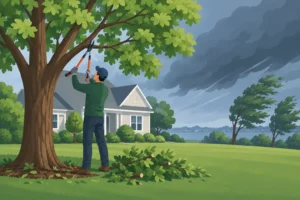
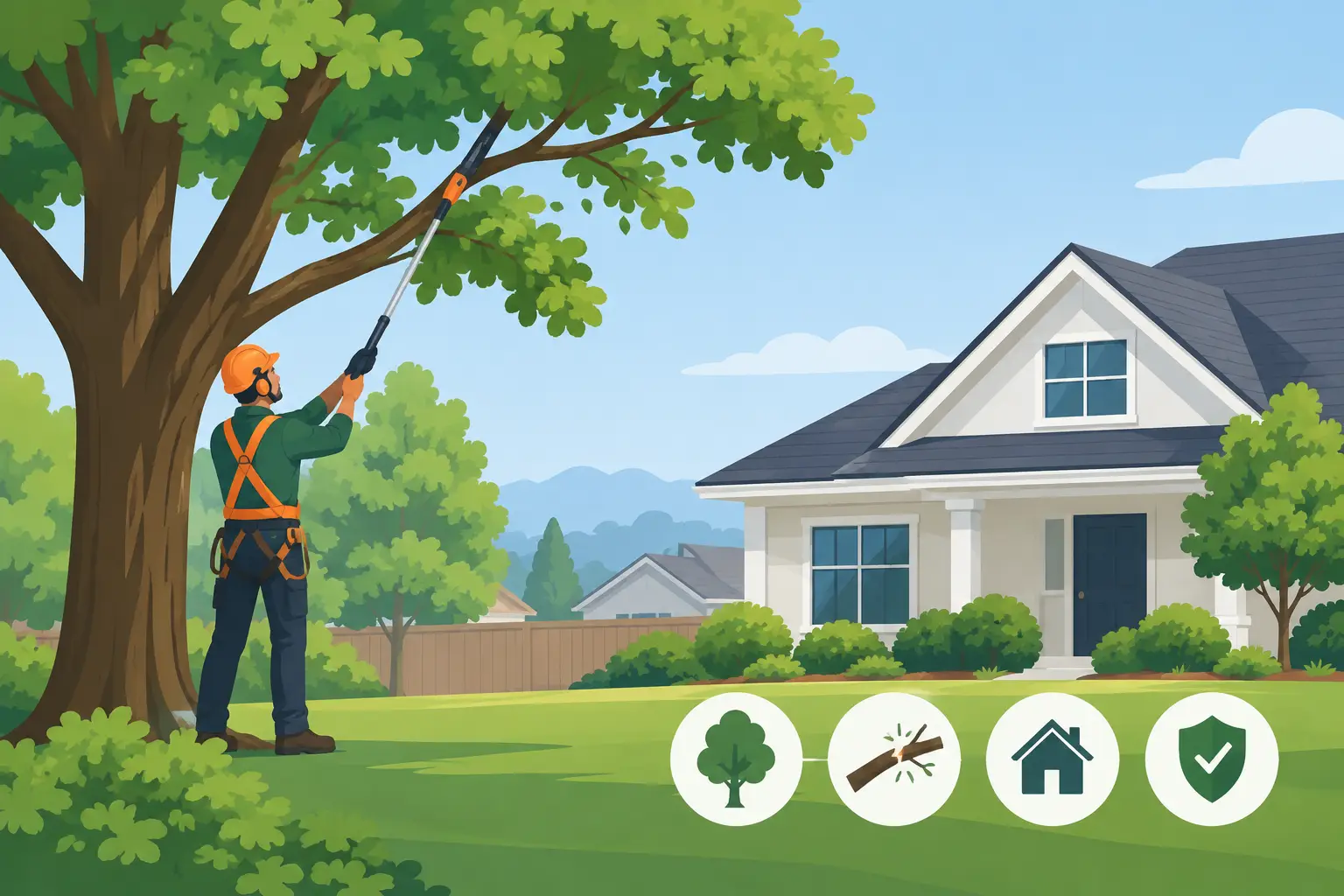
Proper pruning can reduce risk while preserving a tree’s natural form and long-term health. For residential trees, this commonly includes removing deadwood, reducing the length or weight of overextended limbs, improving clearance from roofs and structures, and correcting selected weak or interfering branches.
The quality of the cut matters. Improper topping – cutting large branches back to stubs or indiscriminately reducing the crown – can create weak regrowth, unnecessary decay, and a more hazardous tree over time. A better approach uses targeted reduction cuts that redirect growth to appropriate lateral branches and retain as much sound structure as possible.
Pruning is especially valuable for limbs extending over roofs, service lines, walkways, and outdoor living spaces. It can also improve air movement and reduce the sail effect of an overly dense canopy. Still, more pruning is not always better. Removing too much live foliage can stress a tree, increase sunscald on exposed bark, and trigger rapid, poorly attached shoot growth.
Timing depends on the species and the work required. Dead branches can generally be addressed whenever conditions allow. Structural pruning and work on certain disease-prone trees may be best scheduled during specific periods of the year. A local tree professional can recommend a plan that accounts for both safety and tree health.
When Cabling, Bracing, or Removal Makes Sense
Some mature trees have sentimental, environmental, and property-value importance that makes preservation worthwhile. When a tree has co-dominant stems, a long heavy limb, or a known structural weakness, a properly designed cable or brace system may reduce the likelihood of failure. These systems are not a cure for extensive decay or severe defects, but they can provide support when paired with careful pruning and regular inspection.
Cabling also creates an ongoing responsibility. Hardware should be inspected periodically to confirm that it remains functional and that the tree has not developed new concerns. A support system installed years ago without follow-up may no longer match the tree’s size or condition.
Removal is the responsible choice when risk cannot be reduced to an acceptable level. That may include a tree with advanced trunk or root decay, a severely compromised root system, major storm damage, or a structural defect directly over a high-value target. Removal is also appropriate when a dead tree stands close to a home, driveway, or neighboring property.
For difficult removals, planning protects the property as much as the tree work itself. Crews may dismantle the tree in sections, use rigging to control limbs, and coordinate access around gardens, fences, utilities, and buildings. Homeowners should avoid attempting high-limb pruning or tree removal themselves. Falls, unpredictable wood movement, and hidden decay make this specialized work unsafe without proper equipment and training.
Tree Health Care Supports Long-Term Safety
Hazard mitigation is not limited to responding to visible damage. Many structural problems become more serious when a tree is weakened by drought, compacted soil, insects, disease, nutrient deficiencies, or root injury. Protecting tree health helps preserve the wood strength, root function, and canopy balance that support stability.
Deep root feeding, soil improvement, pest management, and disease diagnosis can be valuable where an underlying health issue is affecting a tree’s vigor. For example, a stressed tree may lose branches more readily during storms, while a tree with declining roots may become less stable as decay progresses below ground. Treatment recommendations should follow a diagnosis, not a routine application schedule that ignores the tree’s actual needs.
Construction planning is equally important. Mature tree roots often extend well beyond the drip line, and compaction or excavation can cause damage that is not visible immediately. Before starting a home addition, drainage project, pool installation, or hardscape renovation, identify trees worth protecting and establish practical root-zone safeguards. Prevention is usually less disruptive and less costly than managing a declining tree after the work is complete.
A Seasonal Approach for Fairfield Properties
Fairfield County weather gives trees plenty to contend with. Summer storms can break weak limbs. Autumn and winter winds reveal structural defects. Heavy snow and ice add weight to broad evergreens and multi-stemmed ornamentals. Saturated spring soil can reduce root stability, especially where drainage is poor.
A thoughtful annual schedule helps homeowners stay ahead of those changes. Consider an inspection before storm season if large trees overhang your home or outdoor spaces. Check the property again after major weather events, particularly if you notice new leaning, hanging branches, cracked limbs, or disturbed soil around the base of a tree.
O Care LLC can help homeowners evaluate tree concerns in the context of the entire landscape, from canopy condition and pruning needs to soil health and plant stress. The most effective recommendation is one that addresses the present risk while supporting the long-term condition of the property.
A tree does not need to be visibly failing to deserve attention. If something about its structure, roots, or canopy has changed, scheduling an informed inspection can turn uncertainty into a clear, manageable plan – and help keep the mature landscape you value safely in place.