A mature oak over a Fairfield driveway can add shade, privacy, and real value to a property. It can also become a serious concern after heavy rain, high winds, construction nearby, or years of unnoticed decline. This mature tree risk assessment guide helps homeowners understand what to watch for, what an arborist evaluates, and when timely tree care can prevent property damage or injury.
Why Mature Tree Risk Is Different
Large, established trees carry more weight, reach farther from the trunk, and often grow close to homes, patios, driveways, utility lines, and play areas. A small failing branch on a young ornamental tree may be manageable. A similar defect in a mature maple or oak can involve hundreds of pounds of wood.
Risk is not the same as poor health. A tree may have thin foliage from drought stress yet pose little immediate hazard. Another tree can look green and vigorous while holding a hidden cavity, compromised root system, or weak branch union. A professional assessment considers both the condition of the tree and what it could strike if it fails.
For Fairfield-area properties, soil saturation is a frequent factor. Long periods of rain can soften soil around a tree with weakened roots, particularly on slopes or in areas with compacted ground. Coastal storms, snow loads, and sudden wind events can then expose problems that have been developing for years.
When to Schedule a Mature Tree Risk Assessment
A tree does not need to be visibly failing before it deserves attention. An assessment is especially worthwhile when a mature tree is within falling distance of a home, garage, driveway, fence, pool, or frequently used outdoor space.
Schedule an inspection after a major storm if you notice newly hanging limbs, shifted soil, cracked branches, or a change in the tree’s lean. It is also wise to have trees evaluated before a renovation, addition, driveway replacement, or excavation project. Root damage often occurs below ground, and its effects may not appear until months or years after construction is complete.
Routine inspections are a practical part of long-term property care. For high-value trees near important targets, a professional review every few years can establish a baseline and catch changes early. Older trees, trees with prior damage, and trees in heavily used landscape areas may need more frequent monitoring.
What a Professional Tree Risk Assessment Includes
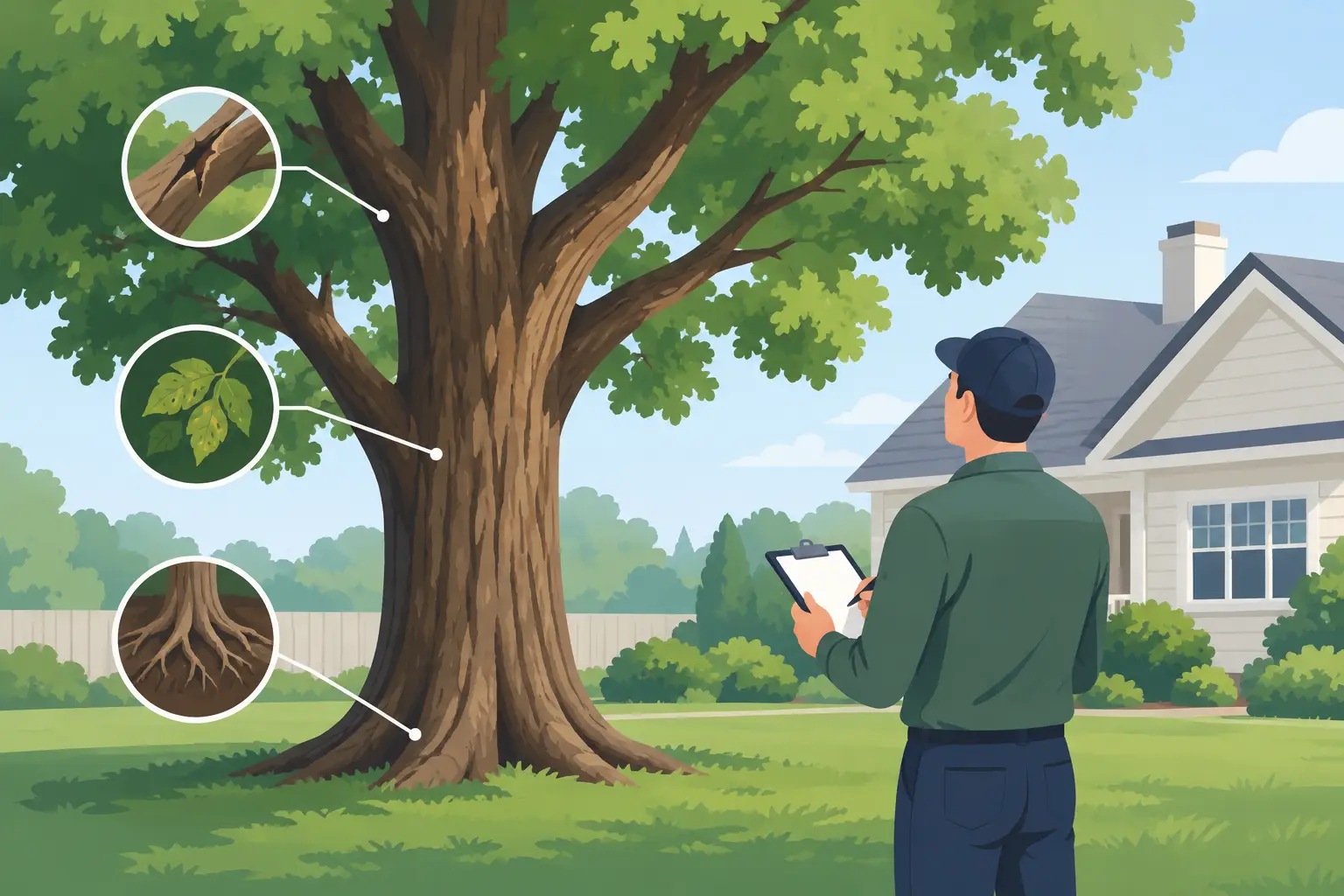
A qualified arborist begins by looking at the full setting, not just the trunk. The question is not simply, “Is this tree healthy?” It is, “What could fail, how likely is failure, and what are the consequences?”
The assessment typically considers the tree species, age, size, growing conditions, branch structure, trunk condition, root zone, and nearby targets. Some species are naturally more prone to particular defects, while others tolerate decay or storm exposure differently. Site history matters as well. Changes in drainage, soil grade, foot traffic, lawn equipment damage, and past pruning can all affect stability.
The arborist will visually inspect the crown for deadwood, broken limbs, crowded branches, and heavy limbs extending over structures. At the trunk, they look for cavities, seams, old wounds, decay fungi, bark cracks, and unions where two stems meet at a narrow angle. Around the base, they check for root flare problems, girdling roots, fungal growth, soil heaving, and root loss.
Not every concern requires removal. In many cases, targeted pruning reduces end weight and removes dead or compromised branches. In others, a properly designed cable or support system can help manage a structurally weak union. When the likelihood and consequences of failure are too high, removal may be the responsible recommendation.
Warning Signs Homeowners Can See
Homeowners should not climb, probe cavities, or remove large limbs themselves. However, a simple ground-level walk around your trees can identify changes worth reporting. Contact a tree care professional promptly if you see any of the following:
- A new or increasing lean, especially with lifted soil or exposed roots on one side of the tree.
- Large dead branches, hanging limbs, or branches that have recently fallen without an obvious storm event.
- Cracks running along a limb, trunk, or the point where major stems join.
- Mushrooms or shelf-like fungi at the base of the tree, which can indicate decay in roots or wood.
- Deep cavities, missing bark, soft or crumbling wood, or a swollen area around an old wound.
- Noticeable thinning, early leaf drop, or dieback concentrated on one side of the canopy.
These signs do not automatically mean a tree is about to fall. Fungi, for example, vary widely, and some trees can live with internal decay for years. The concern increases when multiple symptoms appear together or when the tree stands near a house, walkway, or other important target.
Look Below the Canopy, Too
Root health is one of the most overlooked parts of tree risk. Mature tree roots generally extend well beyond the visible canopy and depend on oxygen, moisture balance, and undisturbed soil. Compaction from vehicles, repeated construction traffic, trenching, grade changes, and poor drainage can weaken roots without leaving an immediate mark on the trunk.
Avoid piling mulch against the bark or creating deep mulch “volcanoes” around the base. Mulch should be spread in a broad, shallow layer and kept back from the trunk. This helps conserve moisture and moderate soil temperatures without trapping excess moisture against the bark.
Deep root feeding and plant health care can support trees affected by nutrient limitations or environmental stress, but treatment is not a substitute for structural evaluation. A healthier tree is beneficial, yet fertilization cannot repair a major crack, reverse severe root loss, or make a hazardous limb safe.
Choosing the Right Response
The best recommendation depends on the defect, the tree’s condition, and the target beneath it. Pruning is often appropriate when the issue is isolated deadwood, a damaged limb, or branches growing too close to a roof. Proper pruning improves clearance and reduces unnecessary weight while preserving the tree’s natural structure.
Cabling or bracing may be considered for certain mature trees with co-dominant stems or a known weak union. This is not a permanent cure, and it requires periodic inspection. Support systems work best when paired with thoughtful pruning and ongoing monitoring.
Removal is sometimes the safest option, particularly when severe decay, root instability, extensive canopy dieback, or major structural defects create an unacceptable risk. Removing a mature tree can be an emotional decision, especially when it has defined the landscape for decades. Still, keeping a tree solely because it is old can expose people and property to avoidable harm.
A responsible arborist should explain the reason for a recommendation in plain language and discuss practical alternatives when they exist. Homeowners deserve to understand whether the goal is to preserve the tree, reduce risk, or both.
Make Tree Monitoring Part of Seasonal Care
Early spring and late fall are useful times to look at branch structure because leaves are limited or absent. Summer reveals canopy density, leaf color, and signs of drought or pest stress. After storms, inspect from a safe distance for new damage before using patios, driveways, or play areas beneath large trees.
Keep a simple record of notable changes, including photographs taken from the same location each season. A widening crack, expanding cavity, or gradual lean is easier for an arborist to evaluate when there is a clear history. If you are uncertain about what you see, caution is appropriate. Keep people and vehicles away from the affected area until it can be evaluated.
For homeowners who value the character and shade of established trees, proactive care is usually the best path. O Care LLC can help assess mature trees, identify practical risk-reduction options, and recommend care that protects both the tree and the landscape around it. A timely professional opinion can preserve a valued tree when possible and provide peace of mind when action is needed.