A mature oak leaning over a driveway, a white pine beside a patio, or a favorite ornamental near the house can become a serious concern when a coastal storm is in the forecast. Knowing how to prepare trees for storms gives Fairfield homeowners time to reduce avoidable risks while protecting the landscape features that add so much value to their property.
Storm preparation is not about cutting back every branch before bad weather arrives. Healthy trees need their canopy to produce energy, regulate growth, and recover from stress. The goal is to identify structural weaknesses, correct them with sound arboricultural practices, and address tree-health issues that can make failure more likely in high wind, heavy rain, snow, or ice.
How to Prepare Trees for Storms Before Weather Turns
The best time to evaluate trees is well before a named storm or a severe thunderstorm warning. Once winds pick up, pruning and tree work become unsafe, and many issues cannot be corrected quickly. A seasonal inspection – particularly before spring and before the fall and winter storm season – provides a clearer view of what needs attention.
Start by looking at each significant tree from the ground. You are not trying to diagnose every concern yourself. You are looking for changes that warrant a professional inspection. Dead limbs, hanging branches, cracks where large limbs join the trunk, cavities, fungal growth at the base, exposed roots, and fresh leaning all deserve attention.
Pay particular attention to trees near your home, garage, driveway, utility lines, fences, play areas, and neighboring property. A branch that falls harmlessly in a wooded corner is different from a branch suspended over a roof or parked vehicles. Location matters when determining how urgently a concern should be addressed.
Look for structural warning signs
Some storm damage is unpredictable, even in healthy trees. However, certain conditions raise the likelihood of branch or tree failure. Watch for the following signs:
- Large dead, broken, or detached branches caught in the canopy
- Multiple trunks with a narrow, V-shaped attachment or visible included bark
- Cracks, splits, or seams in major limbs or the main trunk
- A new lean, lifted soil, or roots pulling up on one side of the tree
- Decay, cavities, mushrooms, or conks near the trunk base
- Dense, overextended limbs reaching toward a structure or utility line
A new lean after heavy rain is especially urgent. Saturated soil can lose its ability to hold a root system securely, particularly around evergreens and trees with restricted or damaged roots. Keep people and vehicles out of the potential fall zone, then arrange a qualified tree inspection promptly.
Use Proper Pruning, Not Aggressive Cutting
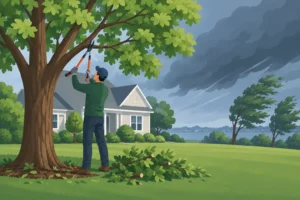
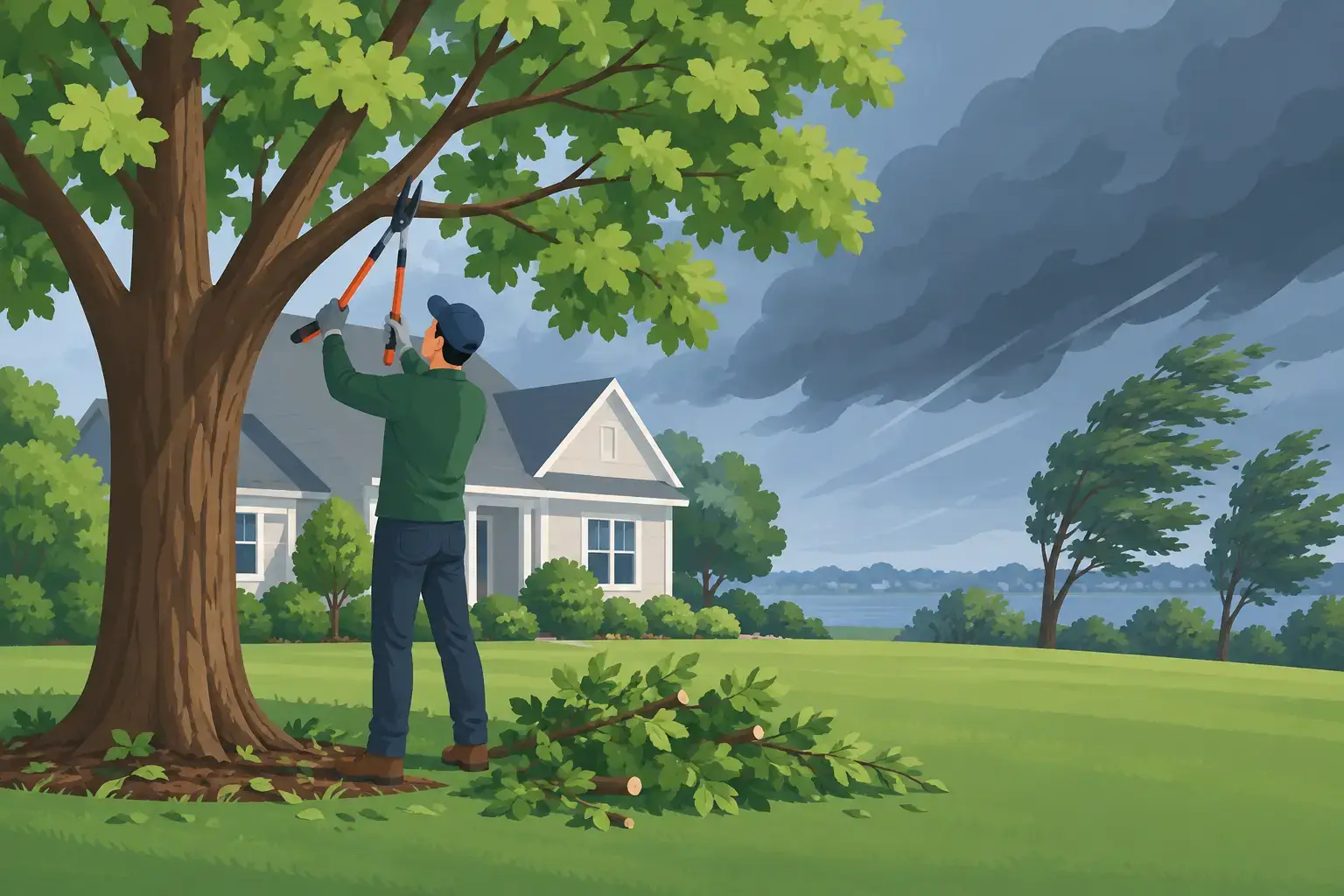
Thoughtful pruning is one of the most effective ways to reduce storm-related branch failure. It removes deadwood, reduces the weight of selected overextended limbs, and improves the structure of young and mature trees. The key word is selected. Proper pruning targets specific problems without stripping away the canopy a tree needs.
Dead branches should be removed before they become airborne hazards. Crossing or rubbing limbs may also need correction, especially when they create weak points or wounds that invite decay. On trees with long, heavy limbs extending toward a roof or driveway, an arborist may use reduction pruning to shorten a branch back to an appropriate lateral branch. This preserves a more natural form than simply cutting a limb to an arbitrary length.
Avoid topping trees. Topping means cutting major limbs or the trunk back to stubs. It can create large wounds, stimulate weakly attached regrowth, and leave the tree more vulnerable over time. It may make a tree look smaller temporarily, but it does not create a safer, healthier structure.
Timing depends on the species, its condition, and the type of work needed. Routine pruning is often best planned outside periods of active stress, but hazardous deadwood or broken limbs should not wait for an ideal season. A professional can recommend the appropriate timing while considering flowering habits, disease concerns, and current weather conditions.
Support Weak Trees When Support Is Appropriate
Not every split or multi-stem tree requires removal. Some trees with valuable, otherwise sound canopies can benefit from professionally installed cabling or bracing. These systems are designed to reduce movement and lower the chance of failure in selected limbs or co-dominant stems.
Cabling is not a permanent substitute for good structure, and it will not make a severely decayed tree safe. It also requires periodic inspection. Still, when used for the right tree and installed correctly, it can help preserve an established specimen that would be difficult to replace.
A certified arborist should assess whether support is suitable. The decision depends on the location of the defect, the amount of decay, the tree species, the targets below it, and the long-term condition of the tree. In some cases, removal is the more responsible option, particularly when a tree presents a high risk to people or property.
Protect the Root System and Soil
Storm readiness begins below ground. Trees rely on a broad network of roots for stability, water uptake, and nutrient storage. Root damage may not be obvious from the canopy, yet it can weaken a tree substantially.
Avoid parking vehicles, storing heavy materials, or repeatedly driving equipment over the root zone. Soil compaction limits oxygen around roots and reduces their ability to function. Construction activity, grade changes, trenching, and excessive fill soil can create problems that appear months or years later.
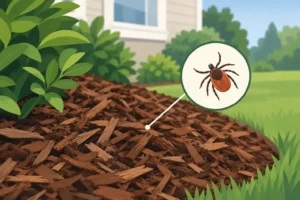
Mulch can help moderate soil temperature and conserve moisture, but it must be applied correctly. Keep mulch in a broad, shallow layer and pull it back from the trunk. Thick piles of mulch against bark hold moisture, encourage pests, and can contribute to root decline.
Watering also matters during dry stretches. Trees entering a storm season under drought stress may be less resilient than adequately hydrated trees. Deep, infrequent watering is generally more useful than frequent light sprinkling because it encourages moisture to reach deeper roots. The right schedule depends on soil type, rainfall, tree age, and species.
For trees showing yellowing leaves, thinning canopy growth, premature leaf drop, or recurring pest damage, tree health care can address underlying stress before it progresses into structural decline. Fertility, insect activity, soil conditions, and disease all affect a tree’s ability to withstand difficult weather.
Do Not Forget the Area Around the Tree
Preparing a tree also means preparing its surroundings. Remove lightweight furniture, planters, grills, and outdoor decorations that could damage trunks or branches in high winds. Keep gutters and drainage areas clear so water moves away from foundations and does not create prolonged saturated conditions around nearby trees.
If branches are close to electrical service lines, do not attempt to prune them yourself. Contact the utility provider or a qualified tree professional who can coordinate work safely. Electrical hazards require specialized procedures, equipment, and clearance standards.
Before a forecasted storm, move vehicles away from large trees when practical. Do not park beneath visibly dead limbs, cracked branches, or trees with a concerning lean. This simple step cannot eliminate risk, but it can prevent avoidable property damage.
What to Do After a Storm
Wait until wind, lightning, and other immediate hazards have passed before walking the property. From a safe distance, look for broken limbs, suspended branches, downed wires, split trunks, and disturbed soil around the base of trees. Treat every downed wire as energized and keep clear of it.
Do not climb ladders, use chainsaws overhead, or try to pull down hung-up branches. Storm-damaged trees can be under tension and may shift without warning. Small debris that is clearly on the ground may be manageable for a homeowner, but larger limbs, uprooted trees, and branches near structures require professional removal.
Photograph visible damage for insurance documentation if necessary, then schedule an evaluation. A tree may look acceptable immediately after a storm but still have cracked limbs or root damage that becomes apparent later. Prompt pruning of torn branches can help limit further damage and support cleaner recovery.
A well-maintained landscape cannot control the weather, but it can reduce preventable hazards. For Fairfield homeowners, regular inspections, correct pruning, attentive tree health care, and timely professional guidance provide a practical way to protect both mature trees and the home they frame. If a tree gives you pause before the next storm, addressing it early is usually the safest decision.