A mature maple that suddenly looks thin in July, a driveway beginning to lift, or a tree that seems to lean more after each heavy rain can all point below ground. Knowing how to spot tree root problems gives Fairfield homeowners a chance to protect valuable trees before a small stress becomes a safety concern or a costly removal.
Tree roots do far more than hold a tree upright. They absorb water and nutrients, store energy, and support the living systems that keep leaves full, branches strong, and growth steady. When roots are damaged, compacted, buried, diseased, or deprived of oxygen, the symptoms often appear first in the canopy or surrounding landscape.
How to Spot Tree Root Problems in Your Yard
Root problems are rarely identified by one sign alone. A healthy tree can lose a few branches after a storm or show modest leaf drop during a dry stretch. Concern grows when several changes appear together, especially when they continue from one season to the next.
Start by looking up. Sparse foliage, smaller-than-usual leaves, early fall color, yellowing leaves, and dieback at the tips of branches can all indicate that roots are not supplying the canopy effectively. These symptoms may also be caused by insects, disease, drought, or nutrient deficiencies, which is why a professional diagnosis matters before treatment begins.
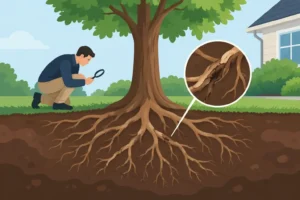
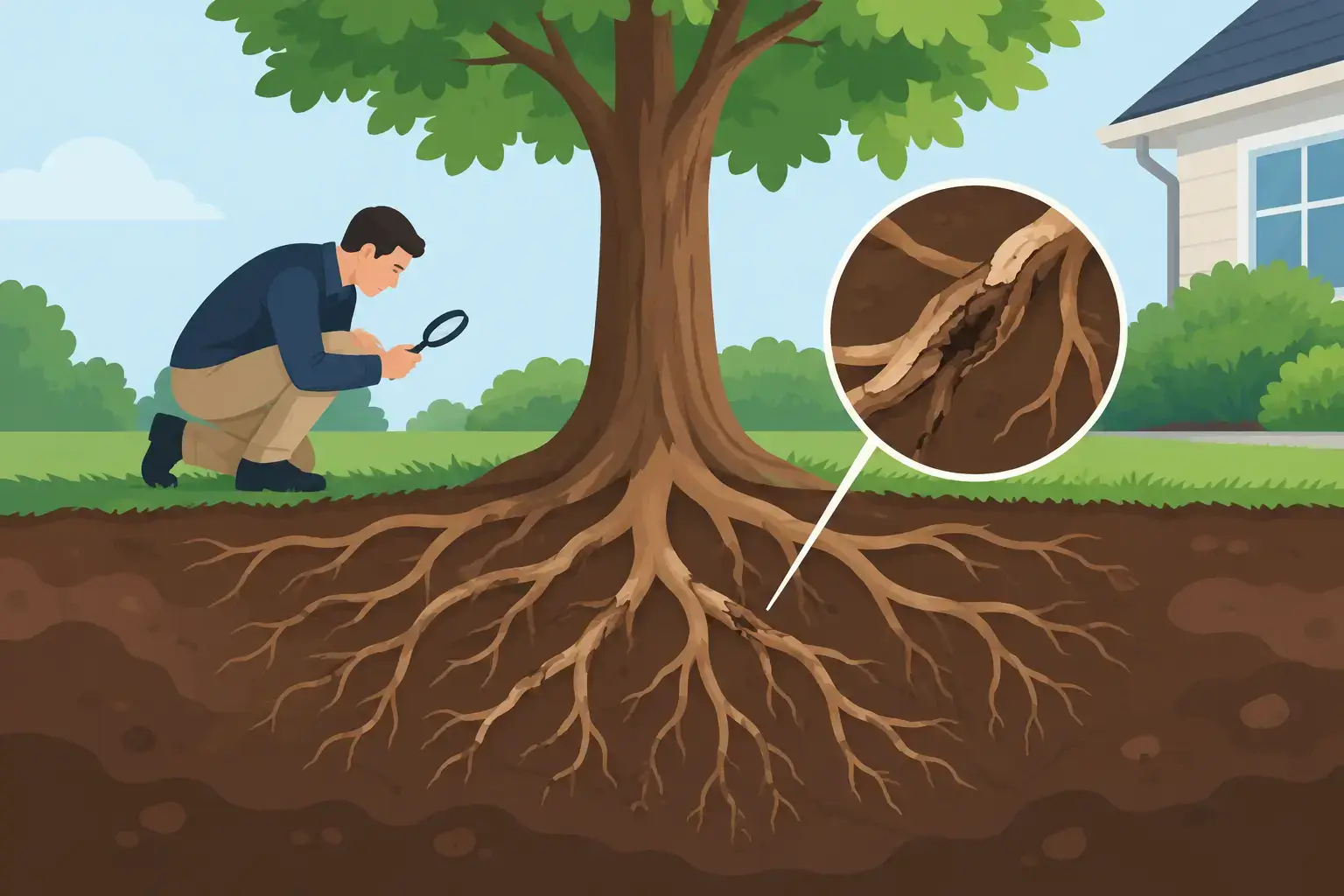
Then look at the ground around the trunk. Soil that is cracked, raised, sunken, or unusually wet may reveal changes in the root zone. Mushrooms or fungal growth near the base of a tree do not automatically mean the tree is failing, but they can signal decaying roots or buried wood. When paired with canopy decline, trunk damage, or a noticeable lean, they deserve prompt attention.
A tree that begins leaning after standing straight for years should always be evaluated. Some trees naturally grow at an angle, particularly along wooded edges. A new lean, however, can mean roots have loosened, broken, or decayed. If the soil on one side of the tree is lifting or the root plate is moving, keep people and vehicles away from the area and arrange an inspection as soon as possible.
Separate Surface Roots From Root Damage
Visible roots are not necessarily a problem. Many mature trees, including maples, beeches, and oaks, develop shallow surface roots as they compete for oxygen, moisture, and room in compacted suburban soils. These roots can make mowing difficult and may lift the edge of a walkway, but their presence alone does not mean the tree is unhealthy.
The concern is when roots are damaged or when surface rooting reflects poor growing conditions. Roots that are cut during patio work, utility trenching, or driveway installation may reduce a tree’s stability and long-term vigor. The effects are not always immediate. A tree can appear fine for a year or more while it uses stored energy, then begin declining during a summer drought or following winter stress.
Avoid cutting large roots simply to make lawn maintenance easier. Removing roots can create decay entry points and weaken the tree structurally. It is also not a good idea to cover exposed roots with a deep layer of soil. Roots need oxygen, and added soil can suffocate the fine feeder roots closest to the surface.
Watch the Root Collar and Trunk Base
The root collar is the transition area where the trunk widens into the roots. On a properly planted tree, this flare should be visible at or just above the soil line. If the trunk enters the ground like a telephone pole, it may be planted too deeply or covered by years of added mulch and soil.
Buried root collars are common in residential landscapes and can lead to chronic stress, bark decay, girdling roots, and poor growth. Girdling roots circle or press against the trunk rather than extending outward. Over time, they can restrict the tree’s ability to move water and nutrients between the roots and canopy.
Mulch volcanoes are another warning sign. Mulch placed several inches deep against the trunk traps moisture against bark, encourages decay, and hides the root flare. A better approach is a broad, shallow mulch ring kept a few inches away from the trunk. Two to three inches of mulch is usually enough to conserve moisture, moderate soil temperatures, and reduce competition from turf without burying critical roots.
Notice Changes After Construction or Drainage Work
Root damage often begins with an otherwise worthwhile property improvement. New additions, retaining walls, pools, drainage projects, patios, and utility work can compact soil or remove roots well beyond the edge of the work area. A tree’s roots commonly extend far beyond the canopy, even though the most important structural roots are often closer to the trunk.
Soil compaction is particularly difficult because it limits the air spaces roots need to function. Heavy equipment, repeated vehicle traffic, and material storage can compress soil enough to affect a tree without leaving an obvious wound. In the months that follow, homeowners may notice reduced leaf size, thinning foliage, poor growth, or increased susceptibility to pests and disease.
Changes in drainage can be equally damaging. Roots may decline when a formerly dry area remains saturated after a grading change or broken irrigation line. On the other hand, redirecting water away from an established tree can create drought stress. In Fairfield’s varied residential landscapes, a root-zone assessment should account for the tree species, soil conditions, slope, nearby hardscape, and recent site changes.
Look for Signs of Root Rot and Instability
Root rot is especially concerning because it can compromise stability before the canopy shows severe decline. Soft, decaying wood at the trunk base, cavities, peeling bark near ground level, or shelf-like fungal growth are reasons to schedule a tree inspection. Some decay fungi affect only dead wood, while others indicate active internal decay, so visual signs need expert interpretation.
Other warning signs include a widening crack in the soil, roots that appear broken or lifted, and sudden branch failure in calm weather. These symptoms do not guarantee that a tree will fall, but they should not be ignored. Trees near homes, driveways, play areas, sidewalks, or neighboring property deserve a timely risk evaluation.
Storms can expose underlying root weakness. After strong wind or saturated soil conditions, inspect trees from a safe distance. Do not pull on a leaning tree, climb it, or try to remove damaged limbs without the proper equipment and training. A compromised tree can shift unexpectedly.
What Homeowners Can Do Before Calling a Professional
A few careful observations will help make a tree assessment more productive. Note when symptoms first appeared and whether they followed construction, flooding, drought, insect activity, or storm damage. Take photos of the full tree, the trunk base, and any affected soil or hardscape. This helps identify whether the condition is changing over time.
Protect the area around the tree while you wait for guidance. Keep vehicles, heavy equipment, and stored materials away from the root zone. Do not apply fertilizer as a default response to decline. Fertilizer can be beneficial when a diagnosis shows a nutrient need, but it will not correct root decay, buried flare roots, poor drainage, or physical injury.
Watering may help a drought-stressed tree, but the right approach depends on soil moisture and weather. Deep, infrequent watering is generally better than daily shallow watering because it encourages moisture to reach active roots. If soil is already wet or drainage is poor, additional water can make the problem worse.
When a Tree Inspection Is the Right Next Step
A certified arborist can assess canopy symptoms, trunk condition, root flare depth, soil compaction, drainage, pest activity, and structural risk as part of one evaluation. Depending on the findings, recommendations may include pruning, root collar excavation, deep root feeding, soil management, pest treatment, cabling, or removal when the tree cannot be retained safely.
There is no single treatment for every root issue. A stressed ornamental tree may respond well to targeted plant health care and better root-zone conditions. A large tree with advanced decay near a home may require a more conservative safety decision. The value of a professional inspection is knowing which path fits the tree, the property, and the level of risk.
Healthy roots are largely out of sight, but their condition shapes every visible part of a tree. If a valued tree is changing, or if the ground around it no longer looks stable, early professional guidance can preserve more options and help keep your landscape safe, attractive, and dependable for years to come.